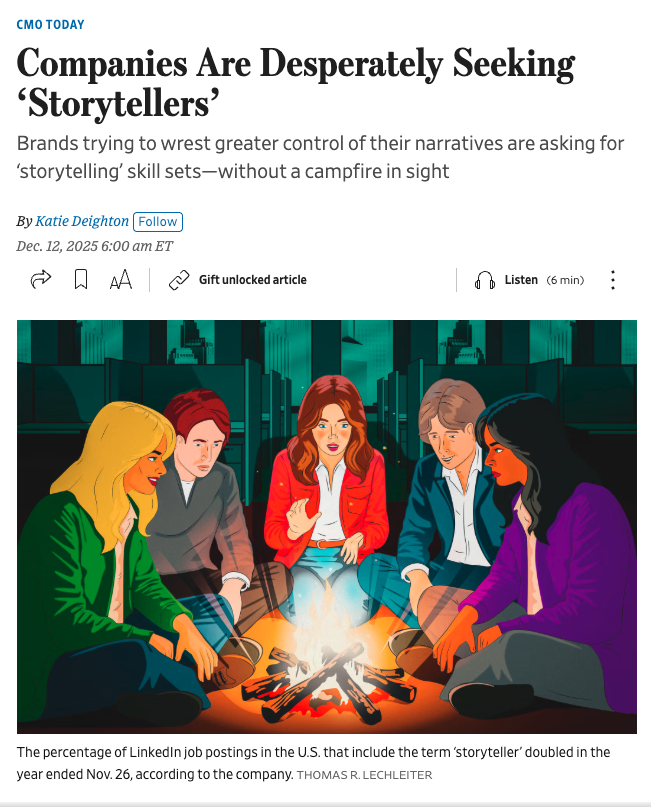
— Wall Street Journal, December 12, 2025
What stories do corporations need to tell? The human stories.
What we know.
What we learned.
Why we do what we do.
What we need you to understand.
Corporations aren’t people. But they are full of people with stories to tell.
Great stories help companies attract top-level employees, display breakthroughs, take the lead in an industry, or earn a trusted reputation.
That matters all the more when large institutions are mistrusted.
In the 1990s, I co-invented a form of organizational storytelling called the “Learning History” that is still practiced today. George Roth and a team of MIT researchers combined management research, journalism and oral history to go inside organizations and bring forth the knowledge of their leaders and innovators.
In the 2000s, as editor-in-chief of strategy+business, I helped CEOs and leaders at many companies tell their stories in our pages.
In the 2020s, Juliette Powell and I designed a form of interactive storytelling for the International Finance Corporation, in which leaders of up-and-coming corporations in developing economies described how they achieved success.
Here are some examples of corporate story-telling where I was the driving force — and can do something similar for you.
Former Procter & Gamble CEO A.G. Lafley recounts how P&G built its innovation culture.
A case study of New Crystal Health Services explains how it went from a clinic to a multifaceted healthcare business serving patients at all income levels.
Another IFC case recounts the remarkable Pyramid Group, which provides pharmaceuticals and diagnostic equipment in central Africa.
John Riady, a turnaround artist appointed CEO of his own family firm Lippo Karawaci, explains the future of Indonesia’s private sector.
or email me at art@artkleiner.com.